Delaware Military Academy, 1859 – 1862

Theodore HyattThe Hyatt Select School for Boy’s prospered and increased in popularity from 1855 to 1858. Then, Hyatt decided to include military drill and uniforms as a required part of the curriculum. Legend would have it that Hyatt wandered into the school gymnasium one day to discover his pupils drilling with broomsticks, and at that time he struck upon the idea of introducing military training. Confident of his new endeavor, Hyatt sought legislative sanction for his military school in 1859. These efforts met with success when the legislature of Delaware convened in January of that year. The adoption of such incorporation, however, appeared to be little more than a name change to Delaware Military Academy.

Almost immediately Hyatt applied to the state for arms and received 80 sword bayonets, 80 cartridge boxes, 14 light artillery sabres, 40 rifles, and two pieces of field artillery. In April, Governor Burton appointed and commissioned Theodore Hyatt as an additional aide-de-camp on his staff with the rank of colonel. In addition, changes to the uniform were also made. Hyatt adopted the cadet gray of West Point rather than the blue of the Hyatt School.

Unfortunately Hyatt had the misfortune of developing DMA at the apex of tension in Delaware preceding the Civil War. An ardent Unionist, Hyatt became embroiled in a controversy with local secessionists regarding the military equipment Delaware had supplied to DMA. Commencement exercises in June, 1862, concluded the short but eventful life of the Delaware Military Academy. Hyatt had decided that it was prudent to seek a more favorable political climate for DMA in West Chester, PA.

The life span of Delaware Military Academy and its predecessors in Delaware covered a total of 41 years. This small academy in Wilmington took a giant stride forward when its young visionary educator was enraptured by his student’s avid interest in exercising with brooms.

Dr. B. Franklin Cooling, III was an Assistant Professor of History at PMC Colleges when he wrote Delaware Military Academy 1859-1862. Currently he is the Chairman of the Grand Strategy Department Industrial College of the Armed Forces, Fort McNair in Washington, D.C. He has graciously granted his permission for the re-publication of his work. To read Dr. Cooling’s complete and detailed history of DMA click here.

Hyatt’s Select School for Boys

Bullock SchoolIn 1821, John Bullock started the Bullock School, a boarding school for boys, in Wilmington, Delaware. He was described as a good teacher, administrator and positive influence on his boys. The school quickly became recognized for its academic instruction and character building. Samuel Alsop, an expert mathematician and friend of Bullock, moved from Philadelphia and became a teacher at the Bullock School. By 1846, Bullock’s health was failing and Alsop had taken over the responsibilities of running the school. After Bullock’s death the following year, Alsop continued to operate the school. He was not interested, however, in expanding it and sold the school and its equipment to Theodore Hyatt in 1853.

Theodore_Hyatt_President_1853-1887Theodore Hyatt made a commanding appearance. He was tall and physically striking. Born in Westchester County, New York, his formative years were spent on a farm. As a youth, he attended the local district school. With the help of the local Presbyterian minister, Hyatt was tutored and entered Union College as a sophomore in 1846. In 1847 he transferred to Princeton University where he graduated in 1849. After graduation, Hyatt accepted an invitation to teach at the parochial school of the local Presbyterian Church in Wilmington, Delaware.

The Bullock School was renamed Hyatt’s Select School for Boys. The academic instruction consisted of English, Science and the Classics. Each Thursday, students spent the day studying composition, declamation (rhetorical exercise), reading, and spelling. In addition each student was expected to spend three hours in recitation. Despite the growing reputation of the school, Hyatt sought methods to impart gentlemanly conduct on his students.

According to legend, in the fall of 1858 Theodore Hyatt observed some of his students practicing military drills with broomsticks in the recreation room of the school. Infantry Drills then became part of the school because they provided physical exercise and impart habits of “order, neatness, system, punctuality, and gentlemanly carriage” in every Cadet. Uniformity was important and Cadets were required to wear uniforms. These consisted of

a frock coat of dark blue cloth, single breasted, with velvet collar to turn down,with one row of ten gilt buttons, of the School pattern, to button up to the throat. The pantaloons will be of dark blue cloth, with a black cord one-eighth of an inch thick set in the outer seam. Caps of black cloth in the school pattern were to be worn.

This was the birth of the military program at PMC. Alumni continue to celebrate the legend of the broomsticks (called “The Broom Drill”) by parading with brooms during Homecoming.


Note: While the “legend” may be true, according the Circular (school catalogue) for 1858, which was printed during the summer, both Infantry Drill and uniforms were to be introduced at the opening of School on September 6, 1858. If the cadets drilled with broomsticks in the fall, it was because the Governor of Delaware had not yet given the school the military arms for drill.

PMC Alma Mater

PMC Alma Mater
Adopted in 1952
Words by Professor Homer Nearing, Jr.
Music by Charles A. Bartlett, ’54
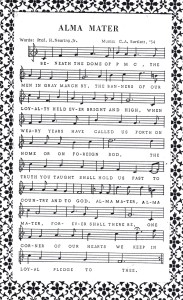
PMC Alma Mater with music